A chandelier can anchor a room or quietly throw it off balance — and more often than not, the difference comes down to size. Hang one that’s too small and it reads as an afterthought; go too large and it crowds the space. The good news: getting it right isn’t a matter of taste so much as a few simple measurements. This guide walks through the formulas designers actually use, room by room, so you can buy with confidence.
The quick formula for chandelier diameter
The fastest way to find a chandelier’s ideal width is to work from the dimensions of the room itself.
- Measure the room. Add the room’s length and width in feet — a 12 ft × 16 ft room totals 28.
- Convert to inches. That sum, expressed in inches, is roughly your ideal fixture diameter. For the room above, aim for a chandelier around 28 inches wide.
This rule keeps a fixture proportional to the volume of the room. For very large or open-plan spaces, treat the area the chandelier actually defines — the seating zone or the dining footprint — rather than the entire square footage.
How high to hang a chandelier
Height is where most installations go wrong. Two reliable benchmarks:
- Over a table or island: leave 30 to 36 inches between the tabletop and the bottom of the fixture.
- In an open room with 8 ft ceilings: the bottom of the chandelier should sit about 7 feet off the floor. Add roughly 3 inches of clearance for every additional foot of ceiling height.
The aim is a fixture that feels present at eye level without anyone ducking beneath it.
Room-by-room sizing
Dining room
Over a dining table, scale to the table, not the room. A chandelier should be about half to two-thirds the width of the table and leave at least 6 inches of breathing room on either side. A 40-inch-wide table pairs well with a 20- to 26-inch fixture. For long rectangular tables, a linear chandelier or a pair of smaller fixtures often reads better than a single round one. Browse our chandeliers for both silhouettes.
Entryway and foyer
An entry chandelier sets the first impression, so err toward generous. Use the room-dimension formula, and in a two-story foyer, center the fixture in the volume so its lowest point clears the second-floor landing and stays well above any door swing. If guests can see it from outside through a window, hang it so it’s framed nicely from the street.
Living room
Living rooms reward a sculptural fixture, but they’re rarely lit by a chandelier alone. Size it to the seating arrangement rather than the full room, and plan to layer in wall sconces and lamps so the chandelier provides shape and ambient glow rather than all the working light.
Bedroom
A chandelier over the foot of the bed or centered in the room adds a quiet sense of occasion. Keep it modest — a 20- to 24-inch fixture suits most primary bedrooms — and prioritize a warm, dimmable bulb over raw brightness.
Kitchen island
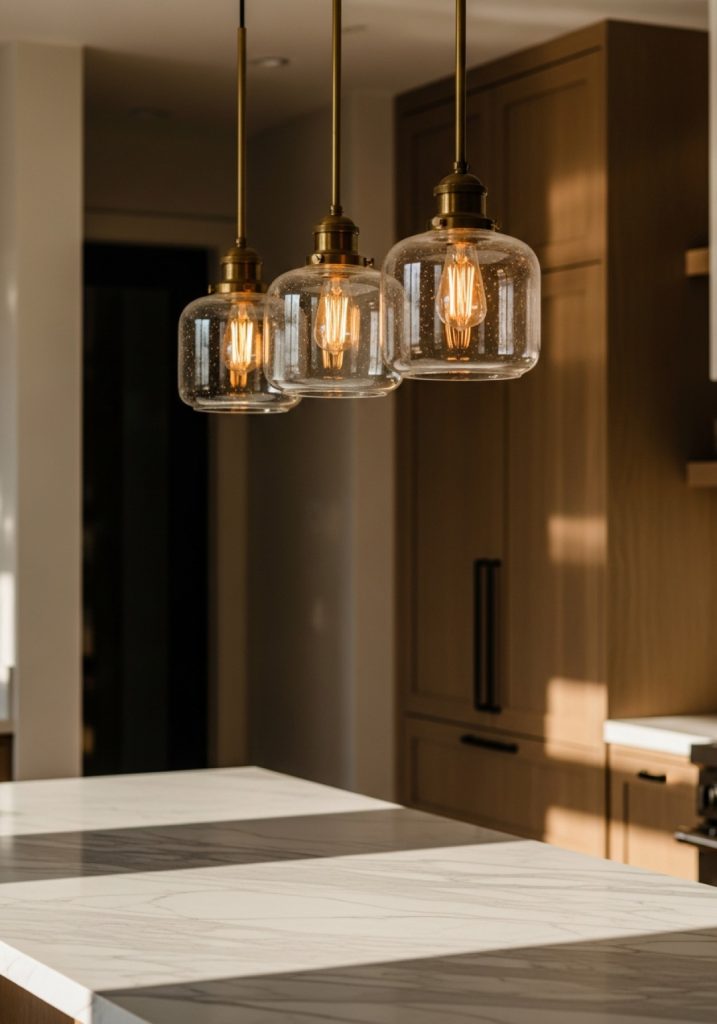
Islands are usually better served by a row of pendants than a single chandelier, since the light needs to spread evenly across a long work surface. We cover the full method — how many, what size, and how far apart — in our guide to pendant lighting over a kitchen island.
Two-story and high-ceiling spaces
Tall rooms can carry a taller fixture, so consider height as well as width — a multi-tier or elongated chandelier fills vertical volume that a flat, wide fixture would leave empty. As a rule, the fixture’s height in inches can roughly equal 2.5 to 3 times the ceiling height in feet.
Matching scale to style
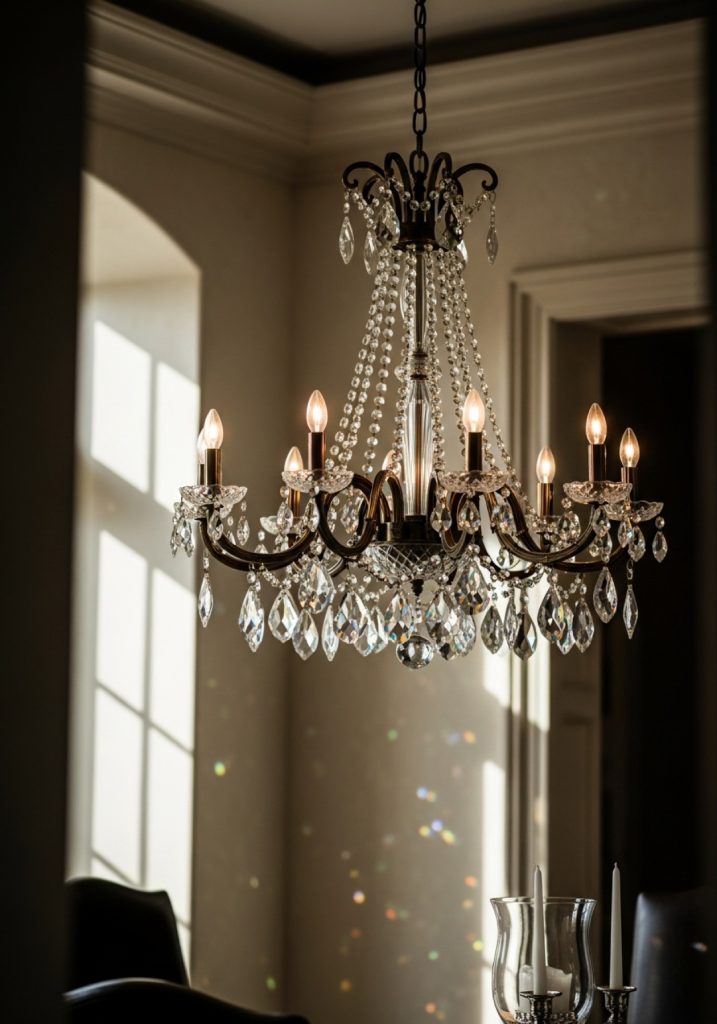
Visual weight matters as much as raw dimensions. An airy fixture in seeded glass or thin metal can run slightly larger without overwhelming a room, while a dense fixture in cast brass, crystal, or solid shades reads heavier and is better kept closer to the smaller end of your range. When in doubt between two sizes, the larger one usually photographs and lives better — undersized lighting is the more common regret.
Common chandelier sizing mistakes
- Sizing to the room instead of the table when hanging over a dining table or island.
- Hanging too high, which makes even a well-chosen fixture feel disconnected from the space.
- Forgetting clearance for door swings, second-floor landings, and the tallest person in the household.
- Skipping the dimmer. Scale and brightness are separate decisions; a dimmer lets one fixture work for both dinners and daylight.
Frequently asked questions
What size chandelier do I need for a 12 × 12 room?
Add 12 + 12 = 24, so look for a fixture around 24 inches in diameter. Nudge smaller for a heavy, solid design or larger for an open, airy one.
How far above a dining table should a chandelier hang?
Leave 30 to 36 inches between the tabletop and the bottom of the fixture. Sit lower (around 30) for intimacy, higher (36) if anyone tends to stand at the table.
Can a chandelier be too big?
Yes — beyond crowding the room visually, an oversized fixture can block sightlines and feel top-heavy. But undersizing is the far more common error, so when you’re between two options, lean larger.
Final thoughts
Chandelier sizing comes down to three numbers: diameter (from the room or the table), hanging height, and clearance. Get those right and almost any silhouette will feel intentional. When you’re ready to choose, explore the full collection of chandeliers — or start with all lighting to see how a statement fixture fits alongside pendants, sconces, and flush mounts throughout the home.